

Around the time I was five or six, I stood on the stairs of my grandparents’ tri-level home, where the cross-stitched design my mother had made of “The Pledge of Allegiance” as a gift for my grandfather—a retired social studies teacher—hung in the stairwell. I read and reread the words, memorizing each line and cadence, practicing until I was certain I knew it by heart. When I felt sure that I could recite each line, I trekked up the stairs, stopped in front of my grandfather’s recliner, placed my hand over my heart, and proudly declared:
“I pledge allegiance to the Flag of the United States of America, and to the Republic for which it stands, one Nation under God, indivisible, with liberty and justice for all.”
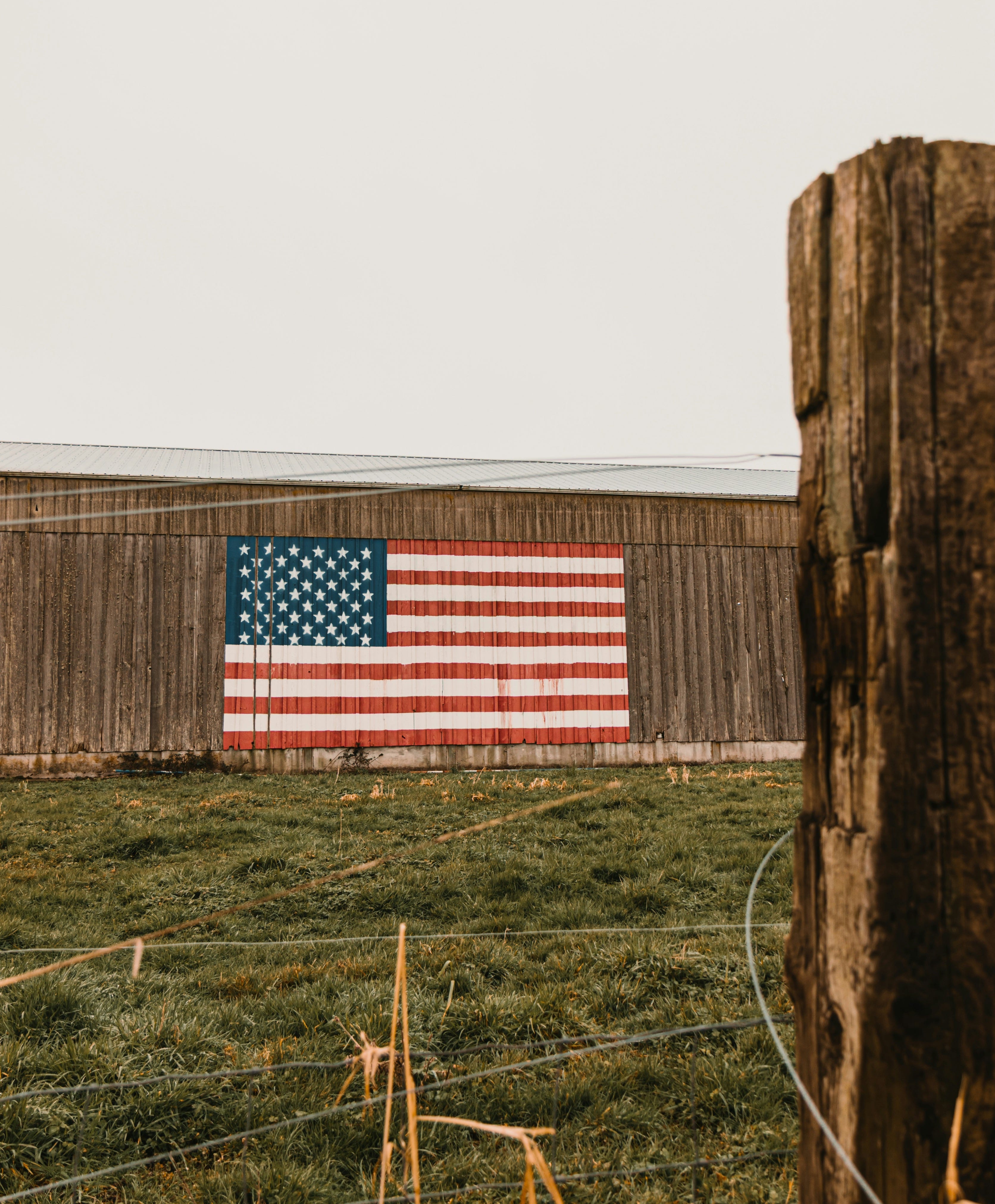
As a child, this verse seemed the perfect way to show my grandfather honor and respect for all his teachings. I loved nothing more than dragging one of the heavy textbooks from his office down the stairs and climbing up in his lap to listen to him speak about the Revolutionary War, George Washington, and the Continental Congress. Even at my young age, I understood the importance of the lessons he was sharing, the complicated and problematic history of the nation, and the hope and promise for a brighter and better future.
My grandfather was a life-long Democrat who was active in both local and national movements. He attended Democratic National Conventions as a delegate, he provided security for presidential candidates during campaign stops in his hometown, and he served as a leader in the local teacher’s union. The year he was president-elect, more than 1,200 school employees marched in protest because the school board was considering referring its negotiation battle with the union to the state’s Supreme Court. In the end, the school board decided against such a move and the following year when he became president of the union, they successfully negotiated contracts for better compensation for staff, including salary checks throughout the year.
Following his retirement from teaching, he ran for a seat on the Papio–Missouri River Natural Resources District (NRD). In my grandfather’s obituary, my uncle is quoted as saying that his service on the NRD seemed a natural extension of his interest in politics and the environment. For my grandfather, it was all connected: caring about a place meant working on it for the betterment of the community.
He was and remains a towering figure in my life. Nearly all of the last conversations with my mother before she died included one or both of us exclaiming how much we wished we could have another conversation with him, to hear his perspective on the trials and tribulations we’ve experienced in the late 20th and early 21st centuries since his passing in the late ‘90s.
So it’s conflicting that, as an adult, I find The Pledge of Allegiance incredibly weird; another bit of American propaganda. But I also understand something now that I couldn’t comprehend as a child. Reciting the pledge to my grandfather wasn’t what made him proud. He was proud because even at that young age, I was already showing an interest in the history and politics of a country he cared deeply about.
As a writer who adores written language, I often struggle with the idiom that “actions speak louder than words”. And yet, that’s the perfect statement to describe my grandfather. He wasn’t simply teaching in a classroom, sharing words that perhaps went unheard. He showed up for his community. He marched, he bargained for better pay for the people who worked beside him, he stood watch at campaign stops, and he served on a board that protected the land and water around him. His love of this country was always in action. He didn’t need to profess it in a pledge, or a song, or by draping himself in flag print.
Over the last decade, symbols like the pledge and the flag have been transformed into grotesque commodities and loyalty tests that claim patriotism. But the behavior and beliefs they are claiming are not patriotism. It’s nationalism, and at its worst, nativism.
Patriotism asks for civic engagement and a willingness to sacrifice for the common good of the community; it holds the country to its promises of a brighter tomorrow, which is what my grandfather did every time he walked into a classroom or marched in protest. It says: “I love my country and want to make it a better place for everyone.”
Nationalism is divisive, aggressive, and exclusionary. It is built on an “us vs. them” model, and it always, always needs someone standing outside the circle to blame. It says: “My country is superior to others, and we must put our interests above everyone else’s.”
Nativism, while closely related to nationalism, goes a step further down the dark path of xenophobia and racism. Whereas nationalists target rival foreign states, nativists target immigrants, minorities, and foreign cultures. It creates two classes of citizens, those who deserve, and those who do not. And they will vote against their own interests if it means the other group suffers. It says: “My group was here first, and immigrants threaten my identity and resources.”
None of this is new. Every generation has had its version of it, and every generation has had people who refused to go along. My grandfather taught the history of all of it, the horrific and the hope, and he never taught it with spotless heroes placed on pedestals. Washington was one of my grandfather’s favorite presidents. And although Washington held beliefs and values that were complicated and problematic, my grandfather never pretended otherwise. What he admired was the selflessness. Washington could have stayed in office as long as he wanted, and he chose to walk away, setting the precedent every president after him would be measured against. But before any of that was decided, he was unsure and afraid of getting it wrong. In January of 1790, he wrote this letter to English historian and early feminist Catharine Sawbridge Macaulay Graham:
The establishment of our new Government seemed to be the last great experiment, for promoting human happiness, by reasonable compact, in civil Society. It was to be, in the first instance, in a considerable degree, a government of accomodation as well as a government of Laws. Much was to be done by prudence, much by conciliation, much by firmness. Few, who are not philosophical Spectators, can realise the difficult and delicate part which a man in my situation had to act. All see, and most admire, the glare which hovers round the external trappings of elevated Office. To me, there is nothing in it, beyond the lustre which may be reflected from its connection with a power of promoting human felicity. In our progress towards political happiness my station is new; and, if I may use the expression, I walk on untrodden ground. There is scarcely any action, whose motives may not be subject to a double interpretation. There is scarcely any part of my conduct wch may not hereafter be drawn into precedent. Under such a view of the duties inherent to my arduous office, I could not but feel a diffidence in myself on the one hand; and an anxiety for the Community that every new arrangement should be made in the best possible manner on the other. If after all my humble but faithful endeavours to advance the felicity of my Country & Mankind; I may endulge a hope that my labours have not been altogether without success, it will be the only real compensation I can receive in the closing Scenes of life.
In this letter, Washington describes not the triumph of victory to the highest office in the land, but his anxiety that his decisions serve the people of the country well. He knows his actions will be interpreted and misinterpreted, and he humbly asks to learn, as the curtain closes on his life, whether his labors were successful in advancing the happiness of the country he cared so deeply for. The glow of the office means nothing to him. The only compensation he hopes for is knowing the people were served.
The United States is and always has been an imperfect country, led by imperfect people, and it deserves a hard and critical examination. But the beauty of this great experiment was that it was always intended to be one of lofty ambition, and never a completed goal: life, liberty, and the pursuit of happiness. And it will require all of us working toward the promise of something better to move us forward.
My grandfather was one of those people. And when it all becomes too much, I curl up in the recliner, legs draped over the arm the way I used to sit with him, and I can imagine the weight of the textbook in my lap. I miss him, and I miss a version of this country that felt like it had people like him in it: people who are unafraid to learn the history, argue about the best path forward, and then come together to build a better tomorrow. Wishing I could ask him what he’d make of all this is like a compass, pointing at what I need, which is to belong to a country that still does that work.
I want to belong to this place without defending my right to it or explaining which version I mean.
These days the flag gets sold, waved, and worn, as proof of belonging, and a lot of people have been made to feel it isn’t theirs. But my grandfather never treated patriotism as something you display. He treated it as something you do, and that kind of patriotism can’t be commodified and it can’t be commandeered, because it was never a symbol to begin with. It’s work, and anyone willing to show up can do it.
And I believe that’s the real testament to my grandfather’s legacy. Because I believe in what the flag stands for: equal justice under law, the dignity of all people, and opportunity regardless of background. I believe in fighting for human rights, civil rights, reproductive freedom, worker protections, environmental preservation, and equality for all. That work is patriotism, and it deserves the symbols as much as anyone does.
When our American symbols meant for everyone are seized, the loudest voices want you to believe they’re gone. The flag, the Fourth, the pledge, the whole inheritance of the United States: they want us to believe those symbols belong to them now, and to them alone, and that the rest of us should walk away. And yet walking away is how they win.
Our Americana heritage isn’t something one group gets to own. It’s inherited, argued over, and stitched back together by the people who willing to do the work. I’d like to be remembered as one of the people who stitches. And someday, I’d like to be able to hang my mother’s cross-stitch in my own stairwell and have it mean only what that little girl inside me thought it meant. She knew the power in the words, and she believed them: with liberty and justice for all.
I still do.
For Your Continued Reading:
The Hill. Democrats: Don’t retreat from the flag, march with it. By Alex Wagner, Opinion Contributor. Jul 23, 2026.
Cosmopolitan. Why I’m Taking Back the Red, White, and Blue This Independence Day. By Aiyana Ishma. Jul 2, 2026.
The Michigan Daily. Reclaiming the American flag like a Midwesterner. By Naomi Rodriguez. Dec 4, 2024.
TIME. To heal America, rethink patriotism. By Dominic Erdozain. Jul 27, 2026.
National Archives. A Letter From George Washington to Catharine Sawbridge Macaulay Graham, 9 January 1790.