

Looking back, the signs were always there. As a child, I was fascinated by both the old family homes and the stories shared within their walls. I would sit for hours listening intently to tales of who came before, or flipping through old photo albums, tracing my fingertips over the yellowed plastic film, wondering how those roots shaped who we were, and who I would become.
For a long time, I carried that curiosity quietly inside myself. When my path diverged in a wood, I took the practical one that had been paved by the expectations placed on all the women before me. As a coping mechanism, I built a wonderful inner world through my writing and my research, where I could escape whenever life got a little too loud. And though that little girl who was drawn to stories and spaces slipped into the shadows, I kept returning to her in fragments that took me far too long to recognize as a whole reflection. The family research, the writing, the way spaces and stories connected for me without even trying—it was her, all along.
That practical path, although paved with good intentions, meandered me off course in search of myself. By the time I had wandered back to the start, past all the boulevards of broken dreams, I realized that what I was searching for wasn’t ahead of me. It was behind me, buried in the roots I’d already spent years digging into. I just didn’t know yet that the calling had a name.
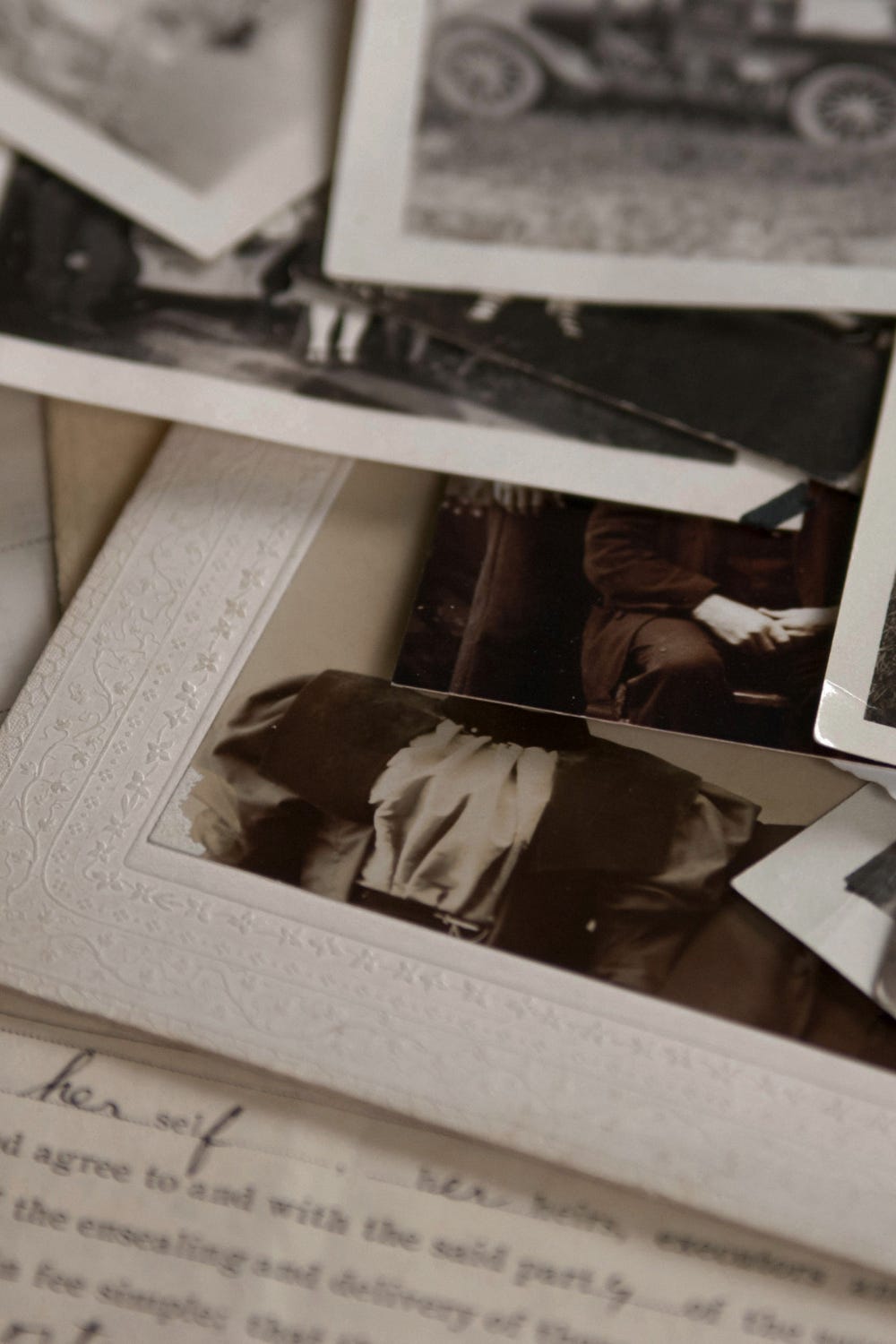
The “Heritage Revival” movement across culture, design, and fashion is often misunderstood as mere nostalgia: a a wistful or sentimental yearning for a return to or the return of some real or romanticized past period or some irrecoverable past condition or setting. Born as a direct counter-response to ultra-minimalist, fast-fashion, and hyper-modern aesthetics, it is frequently grouped alongside trends like “Quiet Luxury,” “Old Money Aesthetic,” and “Grandmillennial.” But Heritage Revival signals something much deeper than a wardrobe change or an interior design trend. It is a profound cultural craving for permanence, craftsmanship, and a tangible, tactile connection to history.
Psychology tells us that nostalgia is often triggered by a familiar smell, sound, or physical experience, serving as an emotional anchor during times of instability, loneliness, or loss. As with all profound emotional longings, it’s rarely about the surface-level thing we think we want: the dream house, the dream job, the dream partner, the dream milestone, or the dream version of ourselves. Instead, these feelings act as a compass pointing toward a fundamental need that’s not being met: the all search for belonging, a desire to be truly seen, the drive to find a higher purpose, and the craving of inner peace in a home we just can’t seem to locate.
As the world turns ever faster, as our days slip one into another, as doomscrolling a 24/7 newsfeed consumes the precious little time we once dedicated to our hobbies— filling our mind, our senses, our beliefs with feelings of inadequacy and fear—it’s easy to see why the past looks so inviting. how nostalgia can appear as the soothing, shushing, blanket of comforting motherly love we all crave.
And yet, Heritage Revival isn’t about going backward. It isn’t an invitation to live in the past, nor is it a blind romanticism of eras that had their own deep flaws.
Rather, it’s about learning from those who came before us to build something that fits the here and now. It’s about slowing down enough to notice that heirlooms aren’t the only objects handed down through generations. Heritage is built into the rhythms of our daily lives, the stories that we tell ourselves, and the traditions we keep year after year.
This is an exploration of that intersection: where the spaces we inhabit meet the rituals that keep us grounded. It is an exploration of design, history, and memory.
Ultimately, it’s about coming home to yourself.
If any of this resonates like the old family albums, the well-worn spaces, the wanting to live a little slower, welcome home, you’re in the right place.